
Mozambique has one of the longest coastlines in Africa, measuring 2,770 km from the mouth of the Rovuma River in the north, which marks the border with Tanzania, to Ponta do Ouro in the south and the frontier with South Africa. Geologically it is located at the western edge of an oceanic ditch, the Mozambique Channel, of which Madagascar, which separated from India some 88 million years ago, forms the eastern side. The Mozambique littoral is marked by several diverse habitats, including beaches, coral reefs, river estuary systems, mangroves, seagrass beds, as well as many offshore islands, most notably the string of Kerimba Islands from Cape Delgado south to Pemba Bay, Mozambique Island (also known simply as the Ilha, or Island, in Mozambique), and Bazaruto Island. It should come as no surprise, then, that throughout its recorded history the peoples who inhabited the coastline of modern Mozambique have experienced an important ongoing relationship with the Indian Ocean.
For historians, the most obvious examples of the connections linking Mozambique to the Indian Ocean center on the export of gold, ivory and slaves and the import of Indian textiles. Politically, the fact that from the early sixteenth century to the mid-eighteenth century Portuguese East Africa was an administrative unit of the larger Estado da Índia, with a Viceroy based in Goa, constituted another prominent Indian Ocean connection. Without minimizing the importance of these linkages, in this paper I want to draw attention to several other elements that have contributed and continue to play a role in the relationship between Mozambique and the Indian Ocean. Specifically, I want to explore the maritime culture of the inhabitants of coastal Mozambique and to highlight more quotidian items of trade between Mozambique and its trading partners across the Mozambique Channel. In addition, I want to acknowledge the human connections that were enmeshed in all of these economic networks.
From indigenous to industrial fishing
At the most basic level the coastal inhabitants of the Mozambique coast share an old culture of boatbuilding, producing a variety of dugout canoes, some with outriggers, others without. Initially, dugouts would have limited seaborne transportation to local coasting and communication along the many rivers that enter the Indian Ocean from the interior. North of the Zambesi River, the addition of outriggers reflects the influence of Austronesian shipbuilding culture that accompanied the maritime settlement of Madagascar over a period from about 400 CE to the end of the first millennium.1 The stabilizing effect of outriggers enabled more secure oceanic communication along the coast, while the addition of sails further enhanced such travel and probably facilitated transportation across the Mozambique Channel to the Comoro Islands and northwest Madagascar. The first sails were probably rectangular and fabricated from woven reeds, like those of the mtepe of the Swahili coast. Eventually, influenced by Arab sailing culture, these were replaced by cloth lateen sails, possibly as early as 900-1000 CE. Sixteenth century Portuguese writers named these dugouts as almadias, while evidence of their seaworthiness is witnessed in the 1505 attack on the fleet of Francisco de Almeida off the coast of Madagascar.2
Outrigger canoes with lateen sails enabled Mozambique fishermen to move from casting nets from the shoreline to exploiting the rich oceanic resources of the Mozambique Channel, although it is likely that most fishers did not venture beyond sight of the coast. These small boats also facilitated communication for short distances up and down the coast with neighboring coastal settlements. This kind of small-scale maritime transportation persists to the current century.3 More recently fishers have employed larger wooden vessels called lanchas that can accommodate crews of twenty men and even today are either rowed or sailed, although some of these larger boats are motorized.4 As one fisherman noted, « Boats used to be of medium size (6-7 m). Now boats are 9-10 m, and we fish with gill nets that can go deep in the open ocean. In the past we didn’t have these things. » Formerly, coastal fishers did not venture into the open sea, where feared spirits resided. Annual ceremonies used to be held « to ask the ancestors for good fishing conditions. »5
Although the archaeological record is thin, it seems likely that fishing provided a valuable protein supplement for the diets of Mozambique’s coastal villagers, as well as a useful item of trade when fish were dried. Archaeological research at Chibuene, 7 km south of Vilanculos on the southern coast of Mozambique, indicates that in its early phases (600-900 CE) marine resources were especially significant, while in its later occupation (1300-1400 to 1650-1700 CE) shellfish assumed greater importance, probably as a consequence of a decline in agriculture caused by climate change.6 Lying offshore about 20 km just to the north of Cabo São Sebastião, archaeological sites on Bazaruto Island indicate links to contemporary mainland settlements like Chibuene. The earliest written accounts of the five islands that comprise the Bazaruto Archipelago depict a wealthy area with several towns populated by « black moors » that were linked to the wider Indian Ocean trading system. The archipelago was the source of a rich variety of marine resources including shellfish, seed pearls, turtle shell, and dugong teeth.7 Coastal northern Mozambique was also rich in shellfish and fish.8
Portuguese accounts from sixteenth-century coastal southern Mozambique mention oysters and fish as components of local diets. In addition, dugong and whales were hunted seasonally, the latter by specialists, with the distribution of both apparently involving many others in these communities and providing months of dried meat and oil.9 Documentation of fishing becomes much more abundant in the eighteenth century ; some of these name varieties of fish, but others are only passing references.10 In the nineteenth century, however, more detailed descriptions of fishing begin to occur as Portuguese officials became more attuned to the development of a modern colony.
During his fortnight’s sojourn at Mozambique Island in August-September 1809 and the Portuguese establishments on the opposing mainland, British diplomat Henry Salt remarked upon the wide variety of « muscles [sic], crabs, and other shell fish, » as well as sea cucumbers, that were available on the coast. In the evening, « a great number of slaves, men, women, and children, were always seen at low water, engaged in collecting shell fish, and the produce of their labour constitutes their chief means of subsistence, » although it seems more likely that this seafood supplemented a diet of manioc, which was widely cultivated on the mainland. Salt also observed that
some of the fishermen use wicker baskets, resembling our eel-baskets, which are left a little beyond low water mark during the flow of the tide, and on its retiring they seldom fail to furnish an ample supply of small fish.11
In September 1829 the Sheikh of the mainland settlement of Cabaceira Pequena, complained to the Portuguese Governor-General that fishermen from the mainland were being harassed at the Ilha’s market. Two years later, during a severe famine that swept across southern Africa, charges were leveled against a fish monger on the island for selling only to preferred customers.12 At the end of the century fresh, salted and fried fish were noted among items for sale at Mossuril, on the mainland opposite Mozambique Island.13
During the futile attempt by the Portuguese to establish a colony at Pemba, on Fernão Veloso Bay, one official reported « a prodigious abundance of fish », but that it was only some Swahili who were engaged in drying fish for sale.14 Half a century after Salt’s brief visit, the Governor of Cabo Delgado, Jeronymo Romero, wrote the first serious assessment of maritime resources along the coast.
In the different seaports along the coast and in the rivers of the district one finds a great abundance of good, varied, and delicious fish, and the natives of the country are regularly engaged with much success in that very important industry.15
He goes on to explain the different methods used to fish, such as by hook and line, traps, and nets, including the materials from which they are manufactured, as well as the boats employed in fishing. Much of the abundant catch was done by slaves of the free inhabitants of Ibo Town, but fishing was freely available to anyone along the coast. Romero also names several varieties of fish and shellfish caught in the waters of the district, including sea bass, perch, swordfish, dorade, shrimp, lobster, clams, and oysters. He notes various marine mammals, as well, but states that they were not hunted along the northern coast.16 At the end of the century, when administrative responsibility for Cabo Delgado was being transferred from the Portuguese Crown to the Nyasa Company, fishing was again noted as a rich resource, although it was regarded as undeveloped both technically and economically. Still, one writer praised the local inhabitants as good fishers and sailors, although his description appears to be lifted from Romero’s account.17 The coast of southern Mozambique continued to be recognized as a rich fishing ground in the nineteenth century, though it was equally undeveloped.18
In addition to fishing for food, other maritime products attracted the attention of the Portuguese because of their potential commercial value : tortoise shell, cowry shells, pearls, and ambergris. The Kerimba Islands and the Sofala coast were both recognized as important sources for these products in the late eighteenth century. One report from that period even mentions a shipment of « good pearls and a quantity of seed pearls » from Sofala to Goa in 1696, while another claims that their quality equals that of the better known pearls of Ceylon.19 Cowries were an important export to both India (Bengal and Surat being specifically identified) and West Africa, the majority being procured in the Kerimba Islands and along that coast.20 In the nineteenth century Indian traders from Chiluane Island collaborated with African pearl divers in the Bazaruto Islands to supply pearls and seed pearls to India. During a famine in the 1880s this industry enabled the fishers to survive by trading their pearls for food.21 In the 1830s Portuguese officials worried about coastal activity by foreign whalers, especially Americans, mainly around Delagoa Bay.22 Exports of cowries remained an important source of revenue for the Portuguese customs house at Ibo in mid-century, while tortoise shell and pearls were regarded as possible sources of income in the early days of the Nyasa Company.23
Although the fishing industry began to attract a certain degree of attention during the modern colonial period, it remained undeveloped.24 A South African geographer noted in the early 1960s,
As in all countries with a long coastline, fish is an important item of food for the coastal populations and the catching of fish, therefore, provides a livelihood for many hundreds of natives. This type of activity, however, is hardly deserving of the title “industry”…25
The fact is, of course, that colonial accounts tended to dismiss the potential of African fishers in the hope that a robust Portuguese fishing industry might develop.26 By the 1960s, only 433 fishers (fewer than 5 % of the total population of the island) were registered at Mozambique, and most of these individuals also worked as sailors on coastal boats. According to Rui Falcão, « Fishing on the Ilha, as along most of the country’s coast, was characterized by technical and technological weakness by virtue of a colonial political economy that made Mozambique a potential consumer of fish produced in the metropole and, later, in Angola ».27 The gaining of independence in 1975, but mainly since the end of the civil war (1977-1992), marked a fundamental change in how government regarded maritime fishing.
In 2013 artisanal fishing, as local fishing is now officially designated, yielded an estimated 222,000 tons of fish and accounted for 87 percent of all national fishing production.28 Historically, the richest fishing zone of the entire coast of Mozambique is the Sofala bank, which constitutes the largest part of the continental shelf. Contemporary fishers based at Zalala Beach, 30 km north of Quelimane, use gill nets, seine nets, and hand lines to secure their catch, about 70 per cent of which is dried, salted, or smoked, with the remainder being either frozen or sold fresh. Most of the catch is sold by middlemen to neighboring districts or consumed by the households of the fishers themselves.29 Over the past two decades, however, the adoption of free-market reforms and demographic pressure resulting from the internal displacement of people from the interior to the coast during the civil war have combined to reduce both the average size of fish available near the shore and the volume of annual catches. As one Zalala Beach fisher lamented, « I have to travel further to catch the fish I want to with my [seine] net. Here, along the edge of the beach, you don’t catch big fish anymore. To catch big fish you need to go to the open ocean with a gill net ».30 As early as 1987 a similar tale of over-fishing appears to have reduced the annual catch and the consequent population of coastal inhabitants who pursued fishing for their living at Pemba Bay, in northern Mozambique. According to the account of a local historian recorded early in the 1990s, « the intensive long-term exploitation both inside and in the offing of the bay rendered the marine resources scarcer ».31 This same lament was reiterated two decades later by Lucas António Matibe, a shrimper from coastal Inhambane Province for more than forty years, who commented on the decline in the number of fish available in those waters.
I can’t explain why they are gone, but each year we catch less and less. I do not know what we would do if the fish disappeared – it is how we feed our families. We are proud of our tradition, but we need help. There are too many fishermen now because there are no jobs, so only those who can compete will survive.32
An equally long history of subsistence fishing exists for the Bazaruto Archipelago, where as recently as the beginning of the current century marine biologists reported that « artisanal fishing with traditional methods is the main economic activity for more than 70 % of the local population » of some 2000 people.33 Reminiscent of Salt’s and Romero’s nineteenth-century descriptions, these methods include
the use of fishing line made from raffia and other plants, stake nets that allow for the passive capture of fish on the change of tides, the drying of fish on frames braided from indigenous vegetation and the use of canoes made from hollowed out tree trunks.
These researchers report that « the most common fishing activity involves the simple gathering by women and children of marine life on the intertidal flats and in the seagrass meadows », where pearl oysters, sea cucumbers, sea urchins, and crabs are found. « Beach seining is a common fishing activity, especially during spring tides on the sheltered western shores » and stake nets are considered to be « an effective means of passive fishing. »34 A different oceanic resource for coastal inhabitants of Mozambique used to be sea turtles, five species of which inhabit Mozambique waters today. In the Bazaruto Archipelago traditional fishing activity formerly included « seasonal gathering of turtles and turtle eggs »35 ; no doubt this practice was followed elsewhere. Whether they were hunted primarily for their meat or eggs or for their shells, sea turtles are now considered to be endangered species and are protected by law against poaching. Conservation efforts can engage local communities and sea turtle observation, as well as scuba diving and sport fishing, has also become a tourist attraction in the resorts of both the Kerimba and Bazaruto Islands.36
In late 2010 the World Wildlife Federation (WWF) and the Mozambican Ministry of Fisheries signed a Memorandum of Understanding to work together to protect marine life and assist fisheries attain sustainability.37 In the culmination of a CARE-WWF Alliance Mozambique initiative, two years later the Government of Mozambique declared the necklace of ten small islands known as the Primeiras e Segundas that lie off the coast between Angoche, in the north, and Pebane, to the south, as an « Environmental Protection Area ». In addition to involving several different government agencies this ambitious project is being managed by a CARE-WWF Alliance and also involves ICRAN, the International Coral Reef Action Network, the UN Foundation, the United Nations Environment Programme, and Conservation International. According to the WWF, covering an area of more than10,410 km2 this marine reserve is the largest in Africa. In the words of Florêncio Marerua, WWF’s Country Director in Mozambique. « This is a great response to the appeal by local communities to help them protect their resources ».38 Indeed, one of the declared features of this multi-faceted project is the close cooperation between project managers and coastal households, both to learn from them and to gain their cooperation in protecting marine resources so that they will thrive in the future. According to a local fisherman named Dino Francisco who heads a seine fishing crew of a dozen men, « Today, the weather is changing, and we don’t know what kind of catch to expect…When I was young, there were a lot more fish. I don’t know why there are less fish now ».39
In addition to climate change, part of the problem causing overfishing goes back to the movement of inland people to the coast in the aftermath of the civil war, as mentioned above. As noted by an older fisher named Ishmael who worked as a translator for the CARE-WWF team on the islands, « The number of fishermen here has been growing in recent years, so we need to understand how to protect the oceans, so people can survive ».40 A key to the success of this ambitious project will be the ability of the project managers to gain support from local communities and fishing associations to secure « their exclusive rights to control their lands and traditional fishing spots », to communicate these concerns to local and national government officials, and to gain « their commitment to put long-term benefits on equal footing with the pressures of the day ».41 Whether these goals articulated by Primeiras e Segundas project manager John Guernier will actually be achieved on the ground remains to be seen, of course, but the project itself seems to be clear evidence that Mozambique is paying greater attention to its marine resources than ever before.
Two specific problems present challenges to efforts to protect Mozambique’s rich fisheries. The first concerns illegal fishing for sharks to supply the apparently insatiable Chinese market for shark fins. The waters of Mozambique support more than 120 different sharks, rays, and skates (elasmobranch species), 20 percent of which are listed as threatened. These fish are among the tourist attractions of southern Mozambique. Some sharks have always been a byproduct of the prawn trawling industry, but a particular concern is the rise of illegal artisanal shark fishing. Although data are slender and virtually non-existent for northern Mozambique, a recent survey reports a camp north of Vilanculos that collected and dried shark fins that were sold to Chinese in Vilanculos. Around Pomene, on the coast about 170 km south of Vilanculos, since 2003 there have been several conflicts over shark fishing. « Resentment built towards these fishers due to their lack of consultation with tribal heads and disregard for tribal laws, and the local community forced these fishers to leave as well ».42
The second problem focuses on tuna fishing. As it happens, how best to exploit and protect the tuna fisheries of Mozambique also raises important questions about how such large development projects are financed and the existence of offshore natural gas fields. Tuna first garnered international attention when a rumor circulated in 2012 that Lonrho’s Oceanfresh Seafood Division had been granted exclusive fishing rights for tuna in both the 12-mile territorial waters and the 200-mile Exclusive Economic Zone (EEZ) of Mozambique.43 Whatever may have been the case, by early 2014 the Government of Mozambique denied categorically that Lonrho had ever possessed these rights.44 In fact, in August 2013 the government created a new state agency named Empresa Moçambicana de Atum SA (EMATUM), or the Mozambique Tuna Company, to organize « the fishery activity of tuna and other fish resources ». According to the Minister of Fisheries, Victor Borges, the reasoning behind this decision was that « tuna fishing in Mozambique is currently dominated by foreign companies ». Out of 130 ships engaged in tuna fishing, he reported that « only one is Mozambican ».45 A month later EMATUM issued the first ever government-guaranteed bond for « financing the purchase of fishing infrastructure, comprising of 27 vessels, an operations centre and related training ».46 Initially issued at US$ 500 million, the value of the bond was subsequently raised to US$ 850 million. According to Prime Minister Alberto Vaquina, « the activity of the company will allow our country, for the first time, to enjoy access to fresh tuna that Mozambicans can eat, thus contributing to better household food and nutritional security ». To be sure, floating this bond has enabled EMATUM to purchase 24 tuna trawlers and six patrol vessels from Constructions Mécaniques de Normandie, a major French ship builder at a cost of about US$ 270 million. This fleet, the Prime Minister stressed « is intended to endow Mozambique with the capacity to exploit one of its own resources, to the benefit of its people and its economy ».47
Since the purchase price of the tuna fleet amounts to less than one-third of the total amount of the bond issue, numerous questions have been raised regarding its actual purpose. International donors, in particular, have questioned if its stated purpose is equally a means to acquire armed boats for Mozambique’s puny navy, whether to protect against piracy or violations of its EEZ by foreign fishing fleets, or more broadly to purchase other military equipment.48 Other worries are that the declared focus on fishing does not jibe with Mozambique’s official Poverty Reduction Strategy Paper.49 A further complication is the discovery of enormous natural gas reserves in Mozambique’s EEZ. As Laura Henson observes in a recent blog,
Most of Mozambique’s discovered hydrocarbon resources are offshore, and the infrastructure needed to extract and export them, such as dredging for pipe-laying, will change aspects of the physical coastline, while prospecting for new fields could affect tuna migration.
The image appears in Laura HENSON, « Natural Gas and Albacore : What Tuna Says About the Future of Mozambique »
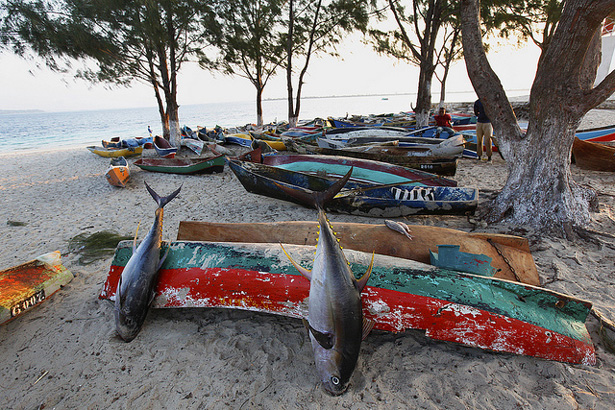
New Security Beat, 13 January 2014, http://www.newsecuritybeat.org/2014/01/natural-gas-albacore-tuna-future-mozambique/
Elsewhere in her article she notes astutely :
If managed justly, the development of a larger, more organized national tuna industry could increase the livelihood stability and economic prosperity for many of these people [artisanal fishers] while keeping marine resource wealth within the country.
How the government balances the development of a national tuna industry and its offshore gas fields – which overlap tuna migration routes – will be an important test for the burgeoning coastal nation.50
Indeed, the larger question is how these ambitious plans to develop both a Mozambican tuna industry and the nation’s offshore gas reserves may in the long term affect the environmental plans to protect the coastline and the trajectory of artisanal fishing in Mozambique.
Indian Ocean networks : goods, people, ideas
Leaving the present and future state of Mozambique’s fishing industry, there remain several other elements in this long history that merit discussion. By the time the Portuguese entered the Indian Ocean at the end of the fifteenth century Mozambican boatbuilding had developed beyond dugouts. Although most large dhows, which were described as zambucos, were probably built either in the Gulf or western India, smaller sea-going versions called bangwas or pangaios were certainly locally manufactured.51 Like their larger models, these vessels were carvel-built, that is with planks laid edge to edge and then sewn together with coir or reed rope and sealed with vegetable matter. They were capable of carrying larger loads along the coast, but also across the Mozambique Channel. In the pre-Portuguese era it was the larger dhows that transported goods between the major ports of Mozambique and those of the wider world of the Indian Ocean.
As early as the ninth century Arab sources indicate that the most important Indian Ocean port of trade in this period was located at Sofala, just south of the mouth of the Buzi River. To Indian Ocean traders, however, the « land of Sofala » included the entire southern coast of Mozambique from the Buzi, across the Sabi River, and possibly as far south as Bazaruto. Although there was a local industry producing iron for export to India, as well as some enslaved captives, Sofala’s claim to fame was as the principal coastal outlet for the gold mines of the Zimbabwe plateau. To the Arabs it was known as « Sofala of the gold (sufālat adh-dhanab) ».52 According to the great medieval Persian scholar al-Biruni (973-1048), the famous Hindu maritime center of Somnath, on the Saurashtra Peninsula of Gujarat in western India, « was a harbor for seafaring people, and a station for those who went to and fro between Sofāla in the country of the Zanj and China ». During the same period, when the Buyid dynasty (932-1044) was in power in Persia, ships from Siraf (the dominant port in the Gulf) also frequented Sofala.53 Although the intrepid Moroccan world traveler Ibn Battuta did not travel south along the coast of eastern Africa beyond Kilwa Kisiwani, when he visited what was then the dominant city-state of the Swahili coast in 1331, he reported, « I was told by a merchant that the town of Súfala lies a fortnight’s journey [south] from Kulwá, and that gold is brought to Sufála » from the interior.54 It is no coincidence that one of the most well-known writings of the leading Arab navigator of the fifteenth century, Ahmad b. Majid al-Najdi, is the long poem entitled al-Sofālīya that describes the route from India to Sofala.
In the fourteenth century Sofala was controlled by the rulers of Kilwa, who a century later had also established an intermediary outpost at Mozambique Island, where a vibrant boat building industry flourished. A century later, partly following internal dissension among political rivals at Kilwa, Swahili and Arab immigrants established new towns at both Angoche and Quelimane to take advantage of the changing routes for transporting gold from the interior to the coast.55 By the time the Portuguese first reconnoitered Sofala, its Muslim ruler had declared himself independent of Kilwa. In the first decade of the sixteenth century, however, the Portuguese seized control of Sofala. They replaced the reigning Muslim ruler with one more to their liking, began construction of a fort near the main Muslim town, and began to trade for gold. Between 1506 and 1513 they sent almost 82 kilos of gold to India, where in 1510 Afonso de Albuquerque established the administrative headquarters of the Portuguese Estado da Índia on the western coast of Karnataka at Goa.56 By this time, however, the gold trade from Sofala was already losing ground to the Zambesi route to Quelimane and Angoche, so that the actual totals of gold exports from Mozambique to India were undoubtedly higher than official Portuguese shipments. Ultimately, the gold sources of the Zimbabwe plateau were limited and by the second quarter of the sixteenth century ivory replaced gold as the most important export of Mozambique.
For the first 250 years of Portuguese presence in East Africa it was dependent upon Goa, where a Viceroy ruled over the Portuguese Indian Ocean thalassocracy. Portuguese governors at Mozambique Island reported to the Viceroy so that all official correspondence went first to Goa before it was sent on to Lisbon. Like all other forms of shipping in the Indian Ocean, communication between Mozambique and India was regulated by the seasonal monsoons. The carreira da Índia, as the royal fleet was designated, not only linked Mozambique to Portugal and India, but also to other outposts of Portuguese administration in the Indian Ocean world.57 One peculiar effect of this reality, peculiar at least for a historian, is that there was an annual flurry of activity each August as the Portuguese fleet readied to depart from Mozambique Island to Goa so official correspondence often bears the same date for many different letters. A more significant impact was the regular landing of the Portuguese fleet, which could double the island’s population and placed enormous strains on the meager resources of the island.58
As in the case of the gold trade, the Portuguese sought to control the export of ivory by establishing new outposts on the coast where they could, at least in theory, tax the trade, which was controlled by African suppliers and Indian Ocean merchants, most of whom were Indians. By 1545 the annual export of ivory from Sofala had risen to 26,000 kilos, which very likely represents the slaughter of more than one thousand elephants.59 A century later the English merchant Nicholas Buckeridge noted a little ivory for sale at Sofala, which he described as being in decline, but more at Inhambane.60 Southern Mozambique remained an important source of ivory exports to India into the eighteenth century, although Sofala was supplanted as the major port along that part of the coast after the Portuguese established a permanent settlement at Inhambane in 1729-1730.61 Three decades later, however, the most important ivory market by far was on the mainland opposite Mozambique Island, which in the 1760s yielded about two-thirds of all ivory entering the Portuguese customs house on the island.62 From the late eighteenth century deep into the nineteenth century ivory was supplanted by the export of enslaved labor, and the first quarter of the latter century witnessed a steady decline in ivory exports from Mozambique. Among several factors causing this decline was the rise of Zanzibar as the principal ivory market of East Africa, to the north, and the combined impact of the expansion of the Gaza Nguni state into the hinterland of southern Mozambique and penetration of the South African Highveld by European hunters, to the south.63
Although the ivory trade had for more than two centuries been the most important economic export linking Mozambique to the Indian Ocean it was the traffic in forced human labor that dominated the nineteenth century. Inhambane and Mozambique Island were the first loci for the export slave trade and the principal destination of African captives from these ports were the developing French colonial plantations located on the Mascarene Islands of Île Bourbon and Île de France.64 During the last decades of the eighteenth century the Kerimba Islands contributed to this trade, as well, both by sending captives down the coast to Mozambique Island for trans-shipment on to the Mascarenes and by welcoming French slavers at its many small ports. At the same time, Arab and Swahili slavers were trading for captive labor to carry north to the slowly developing slave market at Zanzibar, from where they were often dispatched yet again for the Gulf. Emerging from its sleepy past under loose Portuguese overrule, following the administrative separation of Portuguese East Africa from India in 1752, the new Mozambican administration sought to shore up its official presence in the Kerimba Islands, completing a fort at Ibo in the 1770s and a customs house in 1786.65 Ibo now joined Inhambane and Mozambique Island as an important market for the export of enslaved labor to the Mascarenes. A much smaller branch of the Indian Ocean slave trade connected Mozambique to Cape Town.66
In the first three decades of the nineteenth century Mozambique also developed a vigorous slave trade to Rio de Janeiro in which merchants at Mozambique Island and Inhambane both participated. It was, however, the Zambesi delta port of Quelimane that dominated this trade into the South Atlantic.67 For the most part, Quelimane had little connection to the Indian Ocean world and with the exception of some individual Brazilian slavers who included the Mascarenes in their trading activities in the southwest Indian Ocean, this branch of the slave trade did not directly affect the Indian Ocean world.
The British defeat of France in the Napoleonic Wars resulted in the seizure of Île de France in 1810 and its formal transfer to Great Britain by the Treaty of Paris in 1815. Renamed Mauritius, under British rule the slave trade was declared illegal, although slaving under various guises continued until emancipation was effected in 1835.68 Returned to France by the same treaty, Île Bourbon remained a destination for enslaved Africans from Mozambique, as also for Malagasies, until abolition in 1848, when the island was re-designated as La Réunion. While Great Britain was able to meet the post-emancipation labor needs of its burgeoning sugar plantations on Mauritius with indentured labor from India, France was not able to satisfy its labor needs from India, where it now held on to only a tiny foothold at Pondicherry. Accordingly, French planters on Réunion, who were soon joined by their compatriots on the small islands of Nosy Bé, off the northwest coast of Madagascar, and Mayotte (Maore), located closest to Madagascar in the Comoros archipelago, sought to mount a legalized form of the slave trade in the so-called « libres engages » or « free labor emigration » scheme.69 From the 1850s to the 1870s Ibo was the most important point of departure for those individuals unfortunate enough to be caught up in this system. In the 1880s the French made a final attempt to re-invigorate this system of bonded labor migration from Mozambique to Nosy Bé and Mayotte. In June 1881 the Portuguese government declared its official approval of this arrangement, which was then extended to Réunion in 1887. To simplify a complicated story, French attempts to recruit such workers at Ibo failed utterly and a final push to extend the system to Inhambane had only brief and very limited success.70
The traffic in captive Africans from Mozambique was not, of course, limited to French plantations in the southwest Indian Ocean. During the nineteenth century a limited slave trade to the Comoros continued and a new, much larger trade in slave labor flourished to the Sakalava kingdoms of western Madagascar.71 Maritime connections between continental Africa and these offshore islands dated to a much earlier period during which both the Comoros and Madagascar came to be populated and, later, Islam was introduced. During the first two decades of the nineteenth century both the Comoros and the Kerimba Islands were subjected to slave raiding attacks launched by the Betsimisaraka and Sakalava of Madagascar. These raids devastated Ibo and although they never actually reached as far south as Mozambique Island, the Portuguese greatly feared that they might.72 After the Malagasy raids ended, the Sakalava kingdoms of western Madagascar experienced a period of economic activity giving rise to the development of agricultural production that was fueled by enslaved African labor from Mozambique. There is no clearer testimony to the magnitude of this intense period of the forced migration of bonded labor from Mozambique to western Madagascar than the persistence of modern communities of so-called Masombika and Makua in Madagascar. Although these diasporic Africans have lived in Madagascar for more than a century and now speak Malagasy as their first language, a dialect of the Emakhuwa (Makua) language persisted well into the twentieth century and remains a ritual language for many descendants of these Mozambicans, who have been kept at arms’ length by their Malagasy host communities.73
Indeed, wherever Africans from Mozambique were enslaved they were primarily grouped together and identified by those who enslaved them as « Mozambiques », whatever their actual ethnicities or original ports of embarkation. This was as true on the French plantation islands as it was in Madagascar and the Comoros.74 In Mauritius this appellation still bears the stigma of slavery so that being called or referred to by that name is regarded as a personal affront. Yet slave traders and slave owners realized that there were numerous different ethnicities lumped together under the common shorthand name of « Mozambiques ». In the case of Madagascar and the Comoros, however, because of the close connection to the ports of northern Mozambique and the fact that most captive Africans in the nineteenth century belonged to one or another Makhuwa community, « Makua » identity persisted. In Réunion, the name « Nyambane » was given to identify enslaved Africans who had been shipped directly from Inhambane.75 In fact, most of these individuals were undoubtedly Tsonga who had been displaced and then victimized by the Gaza Nguni conquests.
What emerges from this discussion of the slave trade from the various ports of Mozambique to the islands of the southwest Indian Ocean is that the economic factors that linked these far flung places in the eighteenth and nineteenth centuries continue to have everyday ramifications related to the identities and sense of citizenship of the descendants of the enslaved. The same set of factors holds true in varying degrees for Zanzibar, India, and the Gulf, all of which received captives who were shipped from either Mozambique or the Kerimba Islands.76 The case of Afro-Indians of Mozambican origins, who constitute one component of Sidi communities in southern Gujarat and Karnataka, is especially interesting, both because their numbers were small and because they have in recent years become intensely aware of their diasporic connections to Africa, including Mozambique.77
The economic and human connections joining Mozambique to the Indian Ocean were not, however, a one-way traffic. It is well known that the most important commodity that was employed as currency to purchase ivory at Mozambique was Indian textiles. These were mostly cotton stuffs that were manufactured in Gujarat and the Deccan and shipped on Indian dhows from Diu and, to a much lesser extent, Goa.78 The variety of textiles available in western India and the market sensitivity of the African traders who brought ivory to market combined to make this nexus one of the most intricate and demanding of Mozambique’s connections to the Indian Ocean world. Until the infusion of specie, mainly in the form of Spanish dollars or patacas in the late eighteenth and nineteenth centuries to pay for the export of enslaved labor to the Mascarenes and Brazil, Indian textiles dominated the purchase of goods in the ports and interior of Mozambique. When some misfortune, such as shipwreck, or the diversion of a ship to trade at Kilwa, caused the annual supply of Indian textiles to drop, it inevitably caused a panic at Mozambique Island. Only from the middle of the nineteenth century, when plain sheeting (called merikani for its original source in the northern mills of the United States) became the preferred cotton in up-country East Africa, did Indian textiles lose their grip on the Mozambique market. Even then they retained their presence in the market, mostly through the continued appeal of an indigo dyed cloth named kaniki. As late as 1876 a third of Mozambique’s imports came from Bombay and more than 57 per cent of its exports went to that British colonial port. By comparison, less than 3 per cent of its imports and not quite 4 per cent of its exports linked Mozambique to Portuguese India, which included Goa, Diu, and Daman. Not surprisingly, Indian merchants still dominated the import-export trade of Mozambique.79
When French slavers from the Mascarenes began to come to Mozambique Island to obtain labor in the eighteenth century, they discovered the degree to which the Portuguese settlement depended on the importation of food supplies.80 In fact, the inability of Mozambique Island to feed itself was a common feature of the port cities of the Estado da Índia, which « had to rely on foodstuffs imported by sea ».81 Although it was true that in the case of Mozambique Island the Portuguese sought provisions from their very limited mainland holdings and trade with the local Makhuwa, the persistence of regular hostilities rendered vulnerable this undependable source of provisioning. To some extent this problem was overcome by coastal trading with Ibo, as well as from the Swahili ports located to the north of Cape Delgado, but even more important was the development of regular trade in provisions with the Comoro Islands and northwestern Madagascar. Comorian traders from Nzwani regularly carried rice, sorghum, finger millet, a kind of sago used exclusively for feeding slaves, coconuts, goats and cattle, as well as other kinds of foodstuffs. Arab merchants from Zanzibar brought rice and salted beef from the Sakalava port of Bombetoka (in the same bay as modern Mahajanga). Even fresh beef was sometimes shipped to Mozambique.82 A signal testament to the food vulnerability of the Portuguese island came during the devastating southern African famine of 1831, when Governor-General Paulo José Miguel de Brito sent a plea to the rulers of Madagascar, Bombetoka, Nzwani (Anjouan), and Ngazidja (Grande Comore) « to send their pangaois with provisions and cattle to Mozambique ».83 According to British Consul at Mozambique Lyons McLeod writing about Madagascar, in the 1850s « about eighty or ninety tons of rice are exported annually, which is generally bought up by a Portuguese trader for the Mozambique market, who supplies it to the Government of that place for one dollar for one hundred pounds weight ».84 Further evidence of the continued activity of Swahili, Arab, Indian and Malagasy shipping between the ports of Mozambique and those of both the Comoros and western Madagascar is revealed in the numerous passports and records of maritime movement preserved in the extensive nineteenth-century holdings of the Arquivo Histórico de Moçambique in Maputo.85
All of these economic exchanges involved not only the regular presence of merchants and sailors at Mozambique Island, but over time the settlement of specific communities of individuals from other parts of the Indian Ocean world. Mozambique Island was without question the most diverse of the coastal settlements, but it was not unique. Most prominent among the stranger communities in Mozambique (not counting the Portuguese) were Indians. The Indian presence at Mozambique undoubtedly predated the arrival of the Portuguese in the Indian Ocean and afterwards reflected the domination of the trade of ivory for Indian textiles that I have summarized above. In the seventeenth century a small number of Indians, identified in Portuguese records as Canarins (from the coastal region of Kanara to the immediate south of Goa but eventually applied by the Portuguese to Indians of Goa, as well), had settled in the Zambesi valley.86 In 1722 the Indian population of Zambesia was reckoned at 178 individuals ; in the second half of the eighteenth century Canarins and other Indians were counted among the inhabitants and traders of Quelimane, Sena, and Tete.87 Arguably the most powerful Zambesi warlord in the second half of the nineteenth century was a Goan-born Canarim named Manuel António de Sousa, who dominated the entire valley and its southern reaches, collaborating with Portuguese officials to help them secure the interior and to enhance his own personal fortune and family holdings.88
In 1686 the Portuguese authorities granted a Diu-based Indian organization named the Company of Mazanes a monopoly of the trade between that port city and Mozambique. This commercial firm was controlled by members of the Hindu vanīyā guild. In the 1750s the Indian community on the Ilha numbered about 200 souls. Most were Gujaratis and most were vanīyā, although there were some Muslims and Canarins, as well. The dissolution of the Company of Mazanes in 1777 apparently opened up the Mozambique market to a larger number of mainly vanīyā traders. By the early 1780s the Indian community had grown to about 300 individuals, most of whom were single men, or at least married men without their wives, who would have remained in India. By 1830 their population had declined back to 200 with the drop reflecting mainly the loss of a large number of Muslims. Not all these men were merchants, however ; they included cashiers, artisans, and cooks, probably all of them attached in one way or another to the different trading houses.89
Of course, Indians were not the only non-Portuguese to migrate to the Indian Ocean ports of Mozambique during these centuries. Swahili from the coast above Cape Delgado lived among the local Swahili of the Kerimba Islands, as did some Comorians, who were known locally as Mujojos.90 There is also evidence that at least some Comorians had settled around Angoche, where a local chief was named Mujojo Bimo Damune.91 In addition, a significant number of Muslims from western Madagascar, who were known as Antalaotra, fled from political struggles on the Grande Île that featured the Imerina conquest of Mahajanga and its neighboring Sakalava kingdoms in the middle decades of the nineteenth century. The majority of these refugees fled to Zanzibar Town, where they established a Malagasy quarter across the creek at Ng’ambo.92 It seems that at least some Malagasy also settled in Pemba, lying just to the south of the Kerimba Islands.93 In view of the close slave trading connections in the second half of the century between Angoche and Madagascar, it also seems possible that a few Malagasy may have settled in or around Angoche, if only for a short while.94
What I have subsumed under the rubric of « maritime Mozambique » changed significantly with the imposition of effective Portuguese colonial rule. The administrative ties to Portuguese India had long since expired ; indeed, with the declaration of Brazilian independence in 1822 Africa became the focus of the Portuguese empire, which was definitely no longer a thalassocracy. Nevertheless, Portuguese officials took advantage of their western Indian Ocean colonies of Goa and Mozambique by dispatching people convicted of both major and minor crimes, some as insignificant as theft, to serve their sentences in the other territory. Apparently, some criminals from Portuguese India even decided to remain in Mozambique.95
The Portuguese paid little attention to the maritime resources of Mozambique during the twentieth century. The decision in 1902 to remove the Portuguese administrative center from the Ilha to Lourenço Marques (today Maputo), located in the excellent deep water port of Delagoa Bay at the far southern extremity of Mozambique, was a conscious decision to link the economy of Mozambique to the burgeoning mining sector of South Africa. Consequently, rather than flowing out across the waters of the Indian Ocean coerced labor now either moved inland to the mines of the Rand, to the settler plantations of Southern Rhodesia (now Zimbabwe), across the border to British Tanganyika (mainland Tanzania) to work on the sisal plantations or the coconut plantations of Zanzibar, or was directed more forcibly towards cotton cultivation in central and northern Mozambique.96 Certainly, both indigenous shipping and steamships plied the coastal waters of Mozambique, the latter carrying people, mail, and goods from Lourenço Marques to Beira, Quelimane, and the deep water port at Nacala (just to the north of Mozambique Island), which was only developed at the very end of the colonial period, but except perhaps for the employment of Mozambican maritime labor and port workers the connection to the Indian Ocean was clearly reduced under colonialism.97
An important continuity that still linked India to Mozambique was the employment of Christian Goans as colonial civil servants and teachers in Portuguese East Africa.98 In addition, other Indian communities, notably Ismailis from Gujarat, plus Chinese from Portuguese Macao, established small communities in colonial Mozambique. According to the 1928 census of the « non-indigenous » population of Mozambique, Portuguese Indians numbered 3,478, while British Indians totaled 4,997 and « Yellow », which is to say Chinese, counted for 896 individuals.99 The relative size of the British Indian community comes as no surprise, since over the course of the nineteenth century Bombay had emerged as the most important commercial center of the western Indian Ocean. It was also a hotbed of religious activity. Indeed, based on what we know about the religious connections between Bombay and Durban, South Africa, it seems reasonable to assume that both Indian Muslims and perhaps also Parsis in Lourenço Marques experienced similar trans-Indian Ocean influences.100 Today the total Indian population of Mozambique, exclusive of Indian nationals, is reckoned at about 20,000.101
For the most part Islam is more prevalent in northern Mozambique than in the south, where Christianity has established a stronger hold. This regional distinction in religious persuasion is partly a consequence of the long presence of Islam in the Swahili communities of the coast, but it also reflects the late nineteenth- and early twentieth-century expansion of the two major Sufi Ways (turuq ; singular tariqa) from Ngazidja and Zanzibar to Mozambique Island, and thence through Muslim missionary activities into the coastal hinterland. The key figure here was the Hadrami sharif Shaykh Muhammad Maʿruf b. Shaykh Ahmed b. Abi Bakr (1853-1905), who introduced the Yashruti branch of the Shadhiliyya from Moroni, Ngazidja to Mozambique Island in 1897. Less than a decade later the rival tariqa, the Qadiryya, was introduced at the Ilha by Shaykh Isa b. Ahmad from Zanzibar.102
Final thoughts
Although the historiography of colonial Mozambique has focused overwhelmingly on labor and its abuses, while studies of the post-colonial period since independence in 1975 have emphasized the armed liberation struggle, the civil war,103 and development, Mozambique yet maintains a face outward to the Indian Ocean. At the official level Mozambique was a founding member in 1997 of the Indian Ocean Rim Association for Regional Cooperation. It has also established important linkages to Mauritius that are intended to address the human and cultural consequences of the slave trade.104 An altogether different Indian Ocean heritage is the rapid emergence of Mozambique as a tourist attraction known for its beautiful beaches, snorkeling, and sport fishing. No less significant, as I have discussed above, is the parallel development of a national tuna fishing industry and the exploitation of offshore hydrocarbon resources. It is these often overlooked geographical attributes of maritime Mozambique that remain important to the lives of both coastal inhabitants and global visitors.